

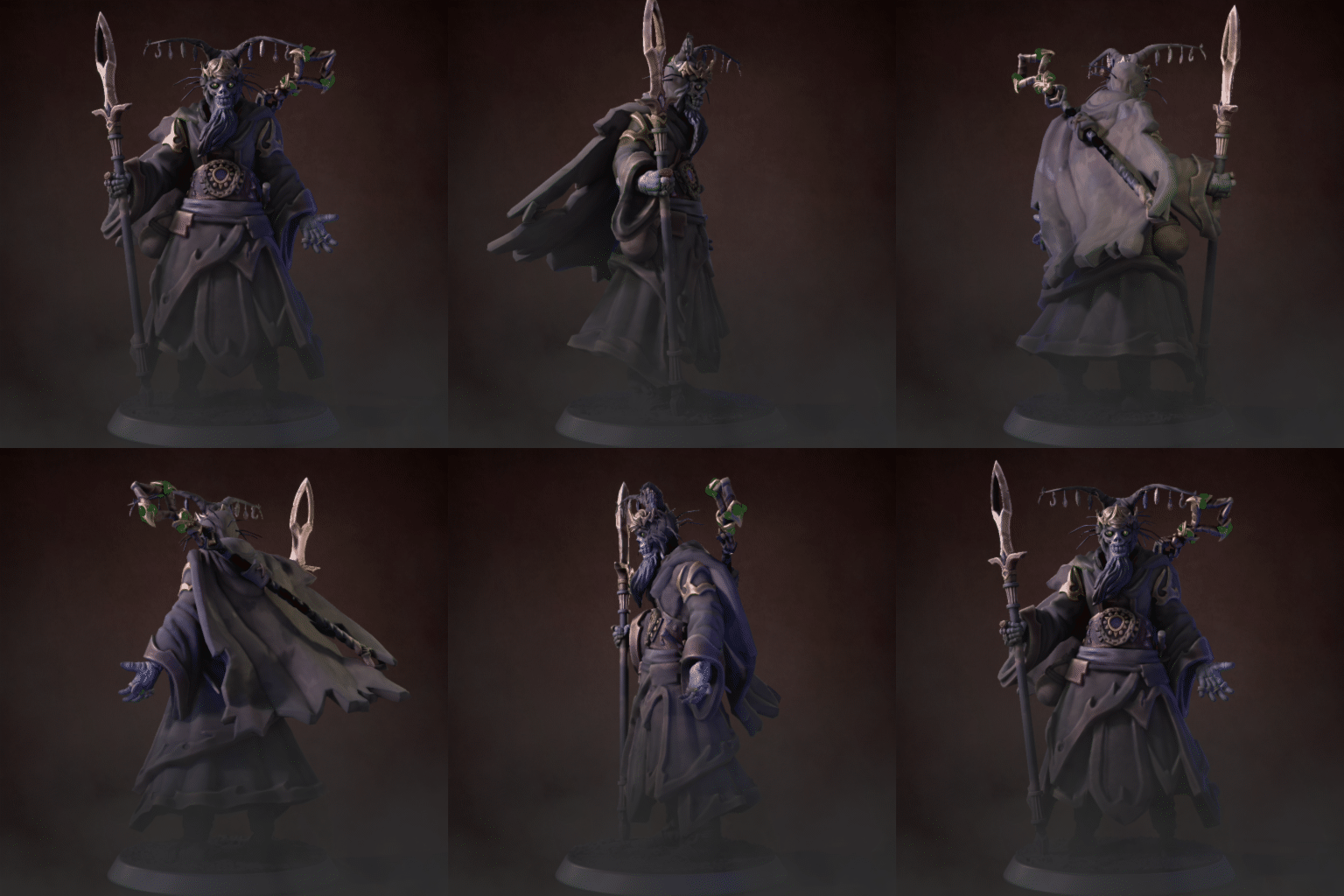
Description
(From 5th Edition Monster Manual - 2014):
Liches are the remains of great wizards who embrace undeath as a means of preserving themselves. They further their own power at any cost, having no interest in the affairs of the living except where those affairs interfere with their own. They hunger for long-forgotten knowledge and the most terrible secrets. Because the shadow of death doesn’t hang over them, they can conceive plans that take years, decades, or centuries to come to fruition.
A lich is a gaunt and skeletal humanoid with withered flesh stretched tight across its bones. Its eyes succumbed to decay long ago, but points of light burn in its empty sockets. It is often garbed in the moldering remains of fine clothing and jewelry worn and dulled by the passage of time.
Secrets of Undeath. No wizard takes up the path to lichdom on a whim, and the process of becoming a lich is a well-guarded secret. Wizards that seek lichdom must make bargains with fiends, evil gods, or other foul entities. Many turn to Orcus, Demon Prince of Undeath, whose power has created countless liches. However, those that control the power of lichdom always demand fealty and service for their knowledge.
A lich is created by an arcane ritual that traps the wizard’s soul within a phylactery. Doing so binds the soul to the mortal world, preventing it from traveling to the Outer Planes after death. A phylactery can take the form of any item possessing an interior space into which arcane sigils of naming, binding, immortality, and dark magic are scribed in silver.
With its phylactery prepared, the future lich drinks a potion of transformation—a vile concoction of poison mixed with the blood of a sentient creature whose soul is sacrificed to the phylactery. The wizard falls dead, then rises as a lich as its soul is drawn into the phylactery, where it forever remains.
Soul Sacrifices. A lich must periodically feed souls to its phylactery to sustain the magic preserving its body and consciousness. It does this using the imprisonment spell. Instead of choosing one of the normal options of the spell, the lich uses the spell to magically trap the target’s body and soul inside its phylactery. The phylactery must be on the same plane as the lich for the spell to work. A lich’s phylactery can hold only one creature at a time, and a dispel magic cast as a 9th-level spell upon the phylactery releases any creature imprisoned within it. A creature imprisoned in the phylactery for 24 hours is consumed and destroyed utterly, whereupon nothing short of divine intervention can restore it to life.
A lich that fails or forgets to maintain its body with sacrificed souls begins to physically fall apart, and might eventually become a demilich.
Death and Restoration. When a lich’s body is broken by accident or assault, the will and mind of the lich drains from it, leaving only a lifeless corpse behind. Within days, a new body reforms next to the lich’s phylactery, coalescing out of glowing smoke that issues from the device. Because the destruction of its phylactery means the possibility of eternal death, a lich usually keeps its phylactery in a hidden, well-guarded location.
Destroying a lich’s phylactery is no easy task and often requires a special ritual, item, or weapon. Every phylactery is unique, and discovering the key to its destruction can be a quest in and of itself.
Lonely Existence. From time to time, a lich might be stirred from its single-minded pursuit of power to take an interest in the world around it, most often when some great event reminds it of the life it once led. It otherwise lives in isolation, engaging only with those creatures whose service helps secure its lair.
Few liches call themselves by their former names, instead adopting monikers such as the Black Hand or the Forgotten King.
Magic Collectors. Liches collect spells and magic items. In addition to its spell repertoire, a lich has ready access to potions, scrolls, libraries of spellbooks, one or more wands, and perhaps a staff or two. It has no qualms about putting these treasures to use whenever its lair comes under attack.
Undead Nature. A lich doesn’t require air, food, drink, or sleep.
A Lich's Lair:
A lich often haunts the abode it favored in life, such as a lonely tower, a haunted ruin, or an academy of black magic. Alternatively, some liches construct secret tombs filled with powerful guardians and traps.
Everything about a lich’s lair reflects its keen mind and wicked cunning, including the magic and mundane traps that secure it. Undead, constructs, and bound demons lurk in shadowy recesses, emerging to destroy those who dare to disturb the lich’s work.
A lich encountered in its lair has a challenge rating of 22 (41,000 XP).
Lair Actions. On initiative count 20 (losing initiative ties), the lich can take a lair action to cause one of the following magical effects; the lich can’t use the same effect two rounds in a row:
The lich rolls a d8 and regains a spell slot of that level or lower. If it has no spent spell slots of that level or lower, nothing happens.
The lich targets one creature it can see within 30 feet of it. A crackling cord of negative energy tethers the lich to the target. Whenever the lich takes damage, the target must make a DC 18 Constitution saving throw. On a failed save, the lich takes half the damage (rounded down), and the target takes the remaining damage. This tether lasts until initiative count 20 on the next round or until the lich or the target is no longer in the lich’s lair.
The lich calls forth the spirits of creatures that died in its lair. These apparitions materialize and attack one creature that the lich can see within 60 feet of it. The target must succeed on a DC 18 Constitution saving throw, taking 52 ((1d8)) necrotic damage on a failed save, or half as much damage on a success. The apparitions then disappear.
(From Monster Manual v3.5 - 2003):
A lich is an undead spellcaster, usually a wizard or sorcerer but sometimes a cleric or other spellcaster, who has used its magical powers to unnaturally extend its life.
As a rule, these creatures are scheming and, some say, insane. They hunger for ever greater power, long-forgotten knowledge, and the most terrible of arcane secrets. Because the shadow of death does not hang over them, they often conceive plans taking years, decades, or even centuries to come to fruition.
A lich is a gaunt and skeletal humanoid with withered flesh stretched tight across horribly visible bones. Its eyes have long ago been lost to decay, but bright pinpoints of crimson light burn on in the empty sockets. Even the least of these creatures was a powerful person in life, so they often are draped in once-grand clothing. Multiclass fighters or clerics may still bear the armor of a warrior. Like its body, however, the garb of a lich shows all too well the weight of years. Decay and corruption are its constant companion.
Liches speak Common plus any other languages they knew in life.
Combat: A lich’s natural weapons are treated as magic weapons for the purpose of overcoming damage reduction.
The Will save against this lich’s fear aura and damaging touch, and the Fortitude save against its paralyzing touch, have a DC of 16.
Wizard Spells Prepared (4/5/5/5/4/2/1; save DC 14 + spell level): 0—acid splash, detect magic, ray of frost*, touch of fatigue; 1st—expeditious retreat, magic missile (3), ray of enfeeblement; 2nd—mirror image, protection from arrows, scorching ray*, spectral hand, web; 3rd—dispel magic, fireball*, haste, lightning bolt*, vampiric touch; 4th—enervation, fear, ice storm*, shout*; 5th—cone of cold*, teleport; 6th—disintegrate.
*Because of Spell Focus (evocation), the save DC for these spells is 15 + spell level.
Possessions: Bracers of armor +4, cloak of resistance +1, potion of gaseous form, ring of protection +1, scroll of summon monster IV (8th level), wand of magic missile (50 charges, 9th level).
CREATING A LICH:
“Lich” is an acquired template that can be added to any humanoid creature (referred to hereafter as the base creature), provided it can create the required phylactery; see The Lich’s Phylactery, below. (Liches of other kinds of creatures, such as dragons, exist, but use different templates.)
A lich has all the base creature’s statistics and special abilities except as noted here.
Size and Type: The creature’s type changes to undead. Do not recalculate base attack bonus, saves, or skill points. Size is unchanged.
Hit Dice: Increase all current and future Hit Dice to d12s.
Armor Class: A lich has a +5 natural armor bonus or the base creature’s natural armor bonus, whichever is better.
Attack: A lich has a touch attack that it can use once per round. If the base creature can use weapons, the lich retains this ability. A creature with natural weapons retains those natural weapons. A lich fighting without weapons uses either its touch attack or its primary natural weapon (if it has any). A lich armed with a weapon uses its touch or a weapon, as it desires.
Full Attack: A lich fighting without weapons uses either its touch attack (see above) or its natural weapons (if it has any). If armed with a weapon, it usually uses the weapon as its primary attack along with a touch as a natural secondary attack, provided it has a way to make that attack (either a free hand or a natural weapon that it can use as a secondary attack).
Damage: A lich without natural weapons has a touch attack that uses negative energy to deal 1d8+5 points of damage to living creatures; a Will save (DC 10 + 1/2 lich’s HD + lich’s Cha modifier) halves the damage. A lich with natural weapons can use its touch attack or its natural weaponry, as it prefers. If it chooses the latter, it deals 1d8+5 points of extra damage on one natural weapon attack.
Special Attacks: A lich retains all the base creature’s special attacks and gains those described below. Save DCs are equal to 10 + 1/2 lich’s HD + lich’s Cha modifier unless otherwise noted.
Fear Aura (Su): Liches are shrouded in a dreadful aura of death and evil. Creatures of less than 5 HD in a 60-foot radius that look at the lich must succeed on a Will save or be affected as though by a fear spell from a sorcerer of the lich’s level. A creature that successfully saves cannot be affected again by the same lich’s aura for 24 hours.
Paralyzing Touch (Su): Any living creature a lich hits with its touch attack must succeed on a Fortitude save or be permanently paralyzed. Remove paralysis or any spell that can remove a curse can free the victim (see the bestow curse spell description, page 203 of the Player’s Handbook). The effect cannot be dispelled. Anyone paralyzed by a lich seems dead, though a DC 20 Spot check or a DC 15 Heal check reveals that the victim is still alive.
Spells: A lich can cast any spells it could cast while alive.
Special Qualities: A lich retains all the base creature’s special qualities and gains those described below.
Turn Resistance (Ex): A lich has +4 turn resistance.
Damage Reduction (Su): A lich’s undead body is tough, giving the creature damage reduction 15/bludgeoning and magic. Its natural weapons are treated as magic weapons for the purpose of overcoming damage reduction.
Immunities (Ex): Liches have immunity to cold, electricity, polymorph (though they can use polymorph effects on themselves), and mind-affecting attacks.
Abilities: Increase from the base creature as follows: Int +2, Wis +2, Cha +2. Being undead, a lich has no Constitution score.
Skills: Liches have a +8 racial bonus on Hide, Listen, Move Silently, Search, Sense Motive, and Spot checks. Otherwise same as the base creature.
Organization: Solitary or troupe (1 lich, plus 2–4 vampires_ and 5–8 vampire spawn).
Challenge Rating: Same as the base creature + 2.
Treasure: Standard coins; double goods; double items. Alignment: Any evil.
Advancement: By character class. Level Adjustment: Same as the base creature +4
LICH CHARACTERS:
The process of becoming a lich is unspeakably evil and can be undertaken only by a willing character. A lich retains all class abilities it had in life.
THE LICH'S PHYLACTERY:
An integral part of becoming a lich is creating a magic phylactery in which the character stores its life force. As a rule, the only way to get rid of a lich for sure is to destroy its phylactery. Unless its phylactery is located and destroyed, a lich reappears 1d10 days after its apparent death.
Each lich must make its own phylactery, which requires the Craft Wondrous Item feat. The character must be able to cast spells and have a caster level of 11th or higher. The phylactery costs 120,000 gp and 4,800 XP to create and has a caster level equal to that of its creator at the time of creation.
The most common form of phylactery is a sealed metal box containing strips of parchment on which magical phrases have been transcribed. The box is Tiny and has 40 hit points, hardness 20, and a break DC of 40. Other forms of phylacteries can exist, such as rings, amulets, or similar items.
(From 2nd Edition Monstrous Manual - 1993):
The lich is, perhaps, the single most powerful form of undead known to exist. They seek to further their own power at all costs and have little or no interest in the affairs of the living, except where those affairs interfere with their own.
A lich greatly resembles a wight or mummy, being gaunt and skeletal in form. The creature’s eye sockets are black and empty save for the fierce pinpoints of light which serve the lich as eyes. The lich can see with normal vision in even the darkest of environments but is unaffected by even the brightest light. An aura of cold and darkness radiates from the lich which makes it an ominous and fearsome sight. They were originally wizards of at least 18th level.
Liches are often (75%) garbed in the rich clothes of nobility. If not so attired, the lich will be found in the robes of its former profession. In either case, the clothes will be tattered and rotting with a 25% chance of being magical in some way.
Combat: Although a lich will seldom engage in actual melee combat with those it considers enemies, it is more than capable of holding its own when forced into battle.
The aura of magical power which surrounds a lich is so potent that any creature of fewer than 5 Hit Dice (or 5th level) which sees it must save vs. spell or flee in terror for 5-20 (5d4) rounds.
Should the lich elect to touch a living creature, its aura of absolute cold will inflict 1-10 points of damage. Further, the victim must save vs. paralysis or be utterly unable to move. This paralysis lasts until dispelled in some manner.
Liches can themselves be hit only by weapons of at least +1, by magical spells, or by monsters with 6 or more Hit Dice and/or magical properties. The magical nature of the lich and its undead state make it utterly immune to charm, sleep, enfeeblement, polymorph, cold, electricity, insanity, or death spells. Priests of at least 8th level can attempt to turn a lich, as can paladins of no less than 10th level.
A lich is able to employ spells just as it did in life. It still requires the use of its spell books, magical components, and similar objects. It is important to note that most, if not all, liches have had a great deal of time in which to research and create new magical spells and objects. Thus, adventurers should be prepared to face magic the likes of which they have never seen before when stalking a lich. In addition, liches are able to use any magical objects which they might possess just as if they were still alive.
Defeating a lich in combat is difficult indeed, but managing to actually destroy the creature is harder still. In all cases, a lich will protect itself from annihilation with the creation of a phylactery in which it stores its life force. This is similar to a magic jar spell. In order to ensure the final destruction of a lich, its body must be wholly annihilated and its phylactery must be sought out and destroyed in some manner. Since the lich will always take great care to see to it that its phylactery is well hidden and protected this can be an undertaking fully as daunting as the defeat of the lich in its physical form.
Habitat/Society: Liches are usually solitary creatures. They have cast aside their places as living beings by choice and now want as little to do with the world of men as possible. From time to time, however, a lich’s interest in the world at large may be reawakened by some great event of personal importance.
A lich will make its home in some ominous fortified area, often a strong keep or vast subterranean crypt.
When a lich does decide to become involved with the world beyond its lair, its keen intelligence makes it a dangerous adversary. In some cases, a lich will depend on its magical powers to accomplish its goals. If this is not sufficient, however, the lich is quite capable of animating a force of undead troops to act on its behalf. If such is the case, the lich’s endless patience and cunning more than make up for the inherent disadvantages of the lesser forms of undead which it commands.
Although the lich has no interest in good or evil as we understand it, the creature will do whatever it must to further its own causes. Since it feels that the living are of little importance, the lich is often viewed as evil by those who encounter it. In rare cases, liches of a most unusual nature can be found which are of any alignment.
The lich can exist for centuries without change. Its will drives it onward to master new magics and harness mystical powers not available to it in its previous life. So obsessed does the monster become with its quest for power that it often forgets its former existence utterly. Few liches call themselves by their old names when the years have drained the last vestiges of their humanity from them. Instead, they often adopt pseudonyms like “the Black Hand” or “the Forgotten King.” Learning the true name of a lich is rumored to confer power over the creature.
Ecology: The lich is not a thing of this world. Although it was once a living creature, it has entered into an unnatural existence.
In order to become a lich, the wizard must prepare its phylactery by the use of the enchant an item, magic jar, permanency and reincarnation spells. The phylactery, which can be almost any manner of object, must be of the finest craftsmanship and materials with a value of not less than 1,500 gold pieces per level of the wizard. Once this object is created, the would-be lich must craft a potion of extreme toxicity, which is then enchanted with the following spells: wraithform, permanency, cone of cold, feign death, and animate dead. When next the moon is full, the potion is imbibed. Rather than death, the potion causes the wizard to undergo a transformation into its new state. A system shock survival throw is required, with failure indicating an error in the creation of the potion which kills the wizard and renders him forever dead.
Demilich:
The demilich is not, as the name implies, a weaker form of the lich. Rather, it is the stage into which a lich will eventually evolve as the power which has sustained its physical form gradually begins to fail. Inmost cases, all that remains of a demilich’s body are a skull, some bones, and a pile of dust.
When it has learned all that it feels it can in its undead life, the lich will continue its quest for power in strange planes unknown to even the wisest of sages. Since it has no use for its physical body at this point, the lich leaves it to decay as it should have done centuries ago.
If the final resting place of a demilich’s remains are entered, the dust which was once its body will rise up and assume a man-like shape. In the case of the oldest demiliches (25%), the shape will advance and threaten, but dissipate without attacking in 3 rounds unless attacked. Younger demiliches (75%) still retain a link to their remains, however, and will form with the powers of a wraith. This dust form cannot be turned. In addition, it can store energy from attacks and use this power to engage its foes. If the dust form is attacked, each point of damage which is delivered to it is converted to an energy point. Since the demilich will fall back and seem to suffer injury from each attack (though none is actually inflicted), its attackers are likely to press on in their attempts to destroy it. Once the demilich has acquired 50 energy points, it will assume a manifestation which looks much like the lich’s earlier undead form and has the powers and abilities of a ghost, but which cannot be turned.
If anyone touches the skull it will rise into the air and turn to face the most powerful of the intruders (a spell user will be chosen over a non-spell user). Instantly, it unleashes a howl which acts as a death ray, affecting all creatures within a 20’ radius of the skull. Those who fail to save vs. death are permanently dead.
On the next round, the demilich will employ another manner of attack. In order to attain the status of a demilich, a lich must have replaced 5-8 (1d4+4) of its teeth with gems. Each of these gems now serves as a powerful magical device which can trap the soul of its adversaries. The physical body of someone hit with the demilich’s spell collapses and rots away in a single round. Once it has drained the life essence from the most powerful member of the party, the skull sinks back to the floor. If it continues to be challenged, the demilich can repeat this attack until all of its gems are filled. An amulet of life protection will prevail over the gem, but the character’s body will perish regardless.
In addition to the attacks mentioned above, a demilich can also pronounce a powerful curse on those who disturb it. These can be so mighty as to include: always being hit by one’s enemies, never making a saving throw, or the inability to acquire new experience points. Demilich curses can be overcome with a remove curse, but the victim loses one point of charisma permanently when the curse is removed.
The skull of a demilich is Armor Class -6 and has 50 hit points. It can be affected by spells in only a few ways: a forget spell will cause it to sink down without attacking (either by howling or draining a soul), a dispel evil will do 5-8 (1d4+4) points of damage to it, a shatter spell will inflict 3-18 (3d6) points of damage to it, a holy word pronounced against it will deliver 5-30 (5d6) points of damage, and a power word kill spell cast by an ethereal or astral wizard will cause the skull to shatter (destroying it).
Most weapons will be unable to harm the skull of a demilich, but there are exceptions. A fighter or ranger with a vorpal sword, sword of sharpness, sword +5, or vorpal weapon can inflict normal damage on the skull, as can a paladin with a vorpal or +4 weapon. Further, any character with a +4 or better weapon or a mace of disruption can inflict 1 point of damage to the skull each time he strikes it.
Upon the destruction of the skull, those who have been trapped inside the gems must make a saving throw vs. spell. Those who fail are lost forever, having been consumed by the demilich to power its magical nature. If the character survives, the gem glows with a faint inner light, and true seeing will reveal a tiny figure trapped within. If the throw is made the soul can be freed by simply crushing the gem. A new body must be within 10 yards for the soul to enter or it will be lost. Such a body might be a clone or simulacrum. (See spells of those names.)
If the fragments of the destroyed skull are not destroyed by immersion in holy water and the casting of a dispel magic the demilich will reform in 1-10 days.
Archlich:
From time to time, sages have heard rumors of liches having alignments other than evil, and even lawful good liches apparently have existed. There have even been reports of priests who, in extreme circumstances, have become liches. These reports have recently been verified, but the archlich is as rare as Roc’s teeth.


Home Plane
Negative Energy Plane, Prime Material Plane
Stat Block
5th Edition:
- Monster Manual (2014)
3rd Edition:
2nd Edition:
Abilities
- 18th level spellcasting
- Paralyzing touch
- Frightening gaze
- Disrupts life from 20 feet
- Turn Resistance
- Legendary Actions
- Legendary Resistance
- Immune to poison, nonmagical attacks, charmed, exhaustion, frightened, paralyzed
- Resistant to cold, lightning, necrotic
- Truesight
-
Appearance
A lich greatly resembles a wight or mummy, being gaunt and skeletal in form. The creature’s eye sockets are black and empty save for the fierce pinpoints of light which serve the lich as eyes. An aura of cold and darkness radiates from the lich which makes it an ominous and fearsome sight. Liches are often (75%) garbed in the rich clothes of nobility. If not so attired, the lich will be found in the robes of its former profession.
Size
Hero Forge: 8'5" (XL)
Lore: Medium (6 ft. tall)
Suggested: Medium
Other Monikers
Lichnee
Sources
- 5th Edition Monster Manual (2014)
- 3.5e Monster Manual (2003)
- 2nd Edition Monstrous Manual (1993)