

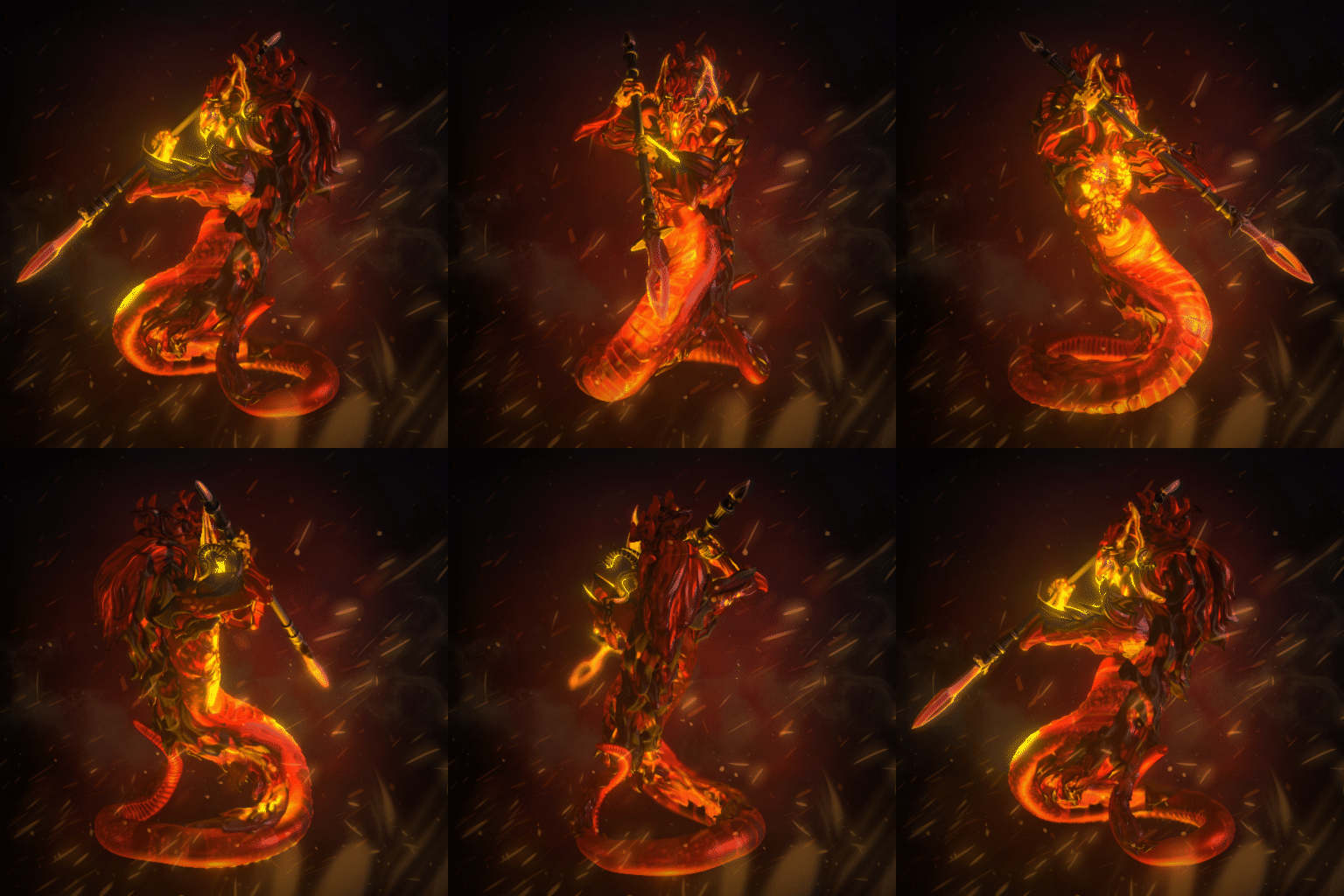
Description
(from 5th Edition Monster Manual - 2014):
Salamanders slither across the Sea of Ash on the Elemental Plane of Fire, their sinuous coils and jagged spines smoldering. Intense heat washes off their bodies, while their yellow eyes glow like candles in the deep-set hollows of their hawkish faces.
Salamanders adore power, and they delight in setting fire to things. Outside their home plane, they play among the burning skeletons of charred trees as forest fires rage around them, or slither down the slopes of erupting volcanoes to linger in fire pits and magma floes.
Fire Snakes. Salamanders hatch from eggs that are two-foot-diameter spheres of smoldering obsidian. When a salamander is ready to hatch, it melts its way through the egg’s thick shell and emerges as a fire snake. A fire snake matures into a salamander adult within a year.
Enslaved by the Efreet. Long ago, the efreet hired azers to build the fabled City of Brass, but then failed in their attempt to enslave that mystical race when the azers’ work was done. Turning instead to strike against salamanders, the efreet conquered and enslaved them, then sent them out to unleash war and destruction across the planes.
Salamanders despise the azers, believing that if the efreet had succeeded in dominating that race of elemental crafters, the salamanders would still be free. The efreet use this enmity to their own advantage, stoking the salamanders’ hatred and pitting them against the efreet’s former servants.
The efreet suffer salamanders to serve no other master; when efreet encounter salamanders dedicated to the cults of Elemental Evil, they slay them rather than enslaving them.
Domineering Nobles. Although salamanders follow the destructive impulses of their fiery nature, slavery under the efreet has impacted the culture of free salamanders. They rule their own societies according to the efreet model, in which larger and stronger salamanders claim dominion over their lesser kin.
As salamanders age, they increase in size and status, rising to positions of power as cruel nobles among their kind. Nobles rule wandering bands of salamanders, which move across the Elemental Plane of Fire like desert nomads, raiding other communities for treasure.
Living Forges. Salamanders generate intense heat, and when they fight, their weapons glow red and sear the bodies of their enemies on contact. Even approaching a salamander is dangerous, since flesh blisters and burns in its proximity.
This inherent heat is an asset to salamanders’ skill as smiths, allowing them to soften and shape iron and steel with their bare hands. Although not as meticulous as azers, salamanders number among the greatest metalsmiths in all the planes. Powerful creatures summon them as warriors, but others enlist the salamanders for their crafting skills, or bind them to forges and ovens to generate limitless heat.
(from 3.5e Monster Manual I - 2003):
This being has a muscular humanoid upper body with a hawkish face. Its body is serpentine from the waist down, and is covered in red and black scales. Flame-shaped spines sprout form the creature’s spine, arms, and head.
The Elemental Plane of Fire is home to many strange creatures, including the fearsome legions of the salamanders. These serpentine beings dwell in metal cities glowing with supernatural heat. Salamanders are selfish and cruel, and they enjoy tormenting others. They are rarely encountered without their heated metal spears, but sometimes wield other weapons.
When summoned to the Material Plane, salamanders often assist forge workers and smiths. Their ability to work metal while it’s still in the fire makes them some of the best metalsmiths known anywhere.
Salamanders reproduce asexually, each producing a single larva every ten years and incubating the young in fire pits until they reach maturity. Flamebrothers and average salamanders are actually different species, while nobles rise from the ranks of the average.
Salamanders speak Ignan. Some average salamanders and all nobles also speak Common.
Combat: Salamanders use metal spears heated red-hot by their own furnacelike bodies. Bloodthirsty and sadistic, they are quick to attack. They prefer to take on those who appear strongest first, saving weaker enemies for slower, agonizing treatment later.
If a salamander has damage reduction, its natural weapons are treated as magic weapons for the purpose of overcoming damage reduction.
Constrict (Ex): A salamander deals automatic tail slap damage (including fire damage) with a successful grapple check. A noble salamander can constrict multiple creatures simultaneously, provided they are all at least two sizes smaller than it.
Heat (Ex): A salamander generates so much heat that its mere touch deals additional fire damage. Salamanders’ metallic weapons also conduct this heat.
Improved Grab (Ex): To use this ability, a salamander must hit a creature of up to one size larger than itself with its tail slap attack. It can then attempt to start a grapple as a free action without provoking an attack of opportunity. If it wins the grapple check, it establishes a hold and can constrict.
Spell-Like Abilities: (Noble salamanders only) 3/day—burning hands (DC 13), fireball (DC 15), flaming sphere (DC 14), wall of fire (DC 16); 1/day—dispel magic, summon monster VII (Huge fire elemental). Caster level 15th. The save DCs are Charisma-based. Skills: Salamanders have a +4 racial bonus on Craft (blacksmithing) checks.
Feats: Salamanders have the Multiattack feat even though they do not have the requisite three natural weapons.
Salamander Society: Flamebrothers, the smallest of the salamanders, are barbaric and tribal. Often more sophisticated salamanders force their civilization upon their smaller kin. Salamander nobility make a point of traveling through the planes, learning secrets to further their power. These experienced creatures eventually return to master their own kind and raise mighty kingdoms.
In a mixed society, status is determined by size and power— flamebrothers are the lowest class and the front ranks of salamander armies. Average salamanders are the middle class and the main fighting force, while noble salamanders are commanders.
Salamander nations do their best to resist the mighty elemental lords on their plane, and they disdain the azers, efreet, and other inhabitants. They often fail, though, and are enslaved by other fiery masters or conscripted into elemental armies.
Salamander Characters: Flamebrothers have no favored class. They sometimes become adepts or warriors. Average or noble salamanders may be clerics, sorcerers, or fighters (their favored class).
(from 2nd Edition Monstrous Manual - 1993):
Most folks have heard of salamanders — the creatures appear more frequently than a body’d think, even off the Elemental Plane of Fire — but few really know the dark of them. See, the creatures’ve got a fairly complex life cycle.
They start their existence in a larval stage, during which time they’re called fire snakes. The name was bestowed by some prime long ago, and unfortunately, it stuck. Some fire snakes eventually mature into what’re called lesser salamanders, while others remain as they are until they die. No one knows why this occurs.
Lesser salamanders aren’t spotted often by most bashers, as they rarely leave their home plane. However, experienced planewalkers know that Fire’s thick with the monsters. Some, but not all, grow and develop into normal salamanders. Only one in a hundred thousand of these creatures has the potential to develop further. These special bloods, if they manage to survive for at least a thousand years, become salamander nobles. This name derives not only from their societal position as leaders, but also from their personal power — nobles’re mighty foes in combat.
Note: This entry describes only lesser salamanders and nobles. For more information on fire snakes and normal salamanders, refer to the Elemental, Fire Kin entry.
Lesser Salamander:
Lesser salamanders, sometimes called flamebrothers, are fairly bestial in nature, possessing only the civilization imposed upon them by their more sophisticated superiors.
Combat: Lesser salamanders use iron weapons in combat. Many wield spears, but others brandish swords, axes, daggers, or maces, all forged entirely of red-hot iron. The body heat of a flamebrother inflicts an additional 2 points of damage upon those struck by its weapon.
Lesser salamanders are immune to fire-based attacks, and sleep, hold, and charm spells. Cold-based attacks inflict 1 additional point of damage per damage die.
Habitat/Society: These creatures of fire and heat dwell in flame-filled caverns on their home plane. They’re usually encountered in huge numbers, often led by a normal salamander. Powerful creatures of the plane of Fire, such as efreet or intelligent elementals, sometimes put lesser salamanders to work as personal guards or soldiers in their armies. Vast nations of flamebrothers may be ruled by many normal salamanders, with a single salamander noble sitting above them all.
Ecology: In the hierarchy of the plane of Fire, lesser salamanders find themselves somewhere near the very bottom. They’re the front-line skirmishers — in other words, the fodder — in the armies of the plane. Many spend their days tending the deep pits of flame where the larval salamanders (fire snakes) grow to maturity.
Salamander Noble:
Enormous armies and huge kingdoms of salamanders (both lesser and normal) serve the nobles of the race, as do most other creatures of heat and flame. Occasionally, however, these formidable bloods wander about alone, even traveling to other planes. Chant is these plane-hoppers are really exiles, banished for their transgressions. Others believe that they simply search for means and methods of seizing more power and that the wandering salamander nobles are free to return to their home at any time. Both theories sound plausible.
Combat: Like their lessers, salamander nobles favor fighting with metal spears, which’re often enchanted with at least a +2 or +3 bonus. The nobles’ great strength adds another 4 points to the damage caused by the spears. And to make matters even worse, the great heat generated by the creatures’ bodies inflicts an additional 1d6 points of fire damage to any berk struck by theyr weapons. If unarmed, a noble can grab a sod with its tail and constrict him, inflicting 2d8+4 points of damage per round, plus another 1d6 points due to its body heat.
Salamander nobles can be struck only by weapons of +2 or better enchantment. They’re immune to heat as well as sleep, charm, and hold spells. However, they can also resist the harmful effects of hated cold, so unlike other salamanders, they suffer only normal amounts of damage from such attacks.
Furthermore, these masters of fire wield potent spellcasting abilities. They can cast each of the following spells three times per day as 10th-level wizards: affect normal fires, burning hands, fireball, flame arrow, flaming sphere, and wall of fire. Once each day, a salamander noble can cast conjure fire elemental and a special form of dispel magic that robs a fire-resistant creature of this protection for 2d4 rounds. This spell negates rings of fire resistance, protection from fire spells, and even the natural resistance of creatures not native to the plane of Fire (such as fiends, red dragons, and so on). It doesn’t work against fire elementals or other creatures native to the plane. Obviously, if cast on a plane-walking sod who’s using special protections to pass safely through the Elemental Plane of Fire, it almost certainly spells his doom.
Habitat/Society: Salamander nobles recognize no authority above their own. They do their best to ignore beings like Imix or Zaaman Rul, and they stay out of the way of powers on the plane of Fire. Some fiery creatures — including certain elementals, grue, azer, mephits, hell hounds, and fire minions — look upon the nobles as masters. The efreet, as a rule, hate the salamander nobles but grudgingly respect their strength.
Despite all their underlings, these powerful bloods are true loners. Since they’re not a race unto themselves, they don’t take mates or raise young. Lesser salamanders fear them too much to give them anything but blind obedience. If life as a salamander noble has any drawbacks, it’s that the tyrant has no confidants, companions, or real allies — only servants.
Most nobles live in fabulous fortresses or palaces on the Elemcntal Plane of Fire. Each is a unique individual with a very different dwelling and personality. But one thing a berk can count on is that all salamander nobles are cruel masters that spend a great deal of time and energy imposing order and organization upon their chaotic lessers.
Ecology: Salamander nobles are among the more powerful creatures on the Elemental Plane of Fire. Their life spans have virtually no limit.
Alternate Versions
Home Plane
Elemental Plane of Fire
Stat Block
5th Edition:
- 5th Edition Monster Manual (2014)
3rd Edition:
2nd Edition:
Abilities
- Heated body, tail and weapons burn creatures upon contact
- Immune to fire
- Resistant to nonmagical attacks
Appearance
This being has a muscular humanoid upper body with a hawkish face.
Its body is serpentine from the waist down, and is covered in red and
black scales. Flame-shaped spines sprout form the creature’s spine,
arms, and head.
Size
Hero Forge: 9 ft. (No Kitbash)
Lore: Large (6-10' long)
Suggested: Large
Other Monikers
Fire salamanders, flamebrothers, lesser salamanders, average salamanders, noble salamanders, salamander fire snakes, salamander inferno lords
Sources
- 2024 Monster Manual (2024)
- 5th Edition Monster Manual (2014)
- 3.5e Monster Manual I (2003)
- 2nd Edition Monstrous Manual (1993)